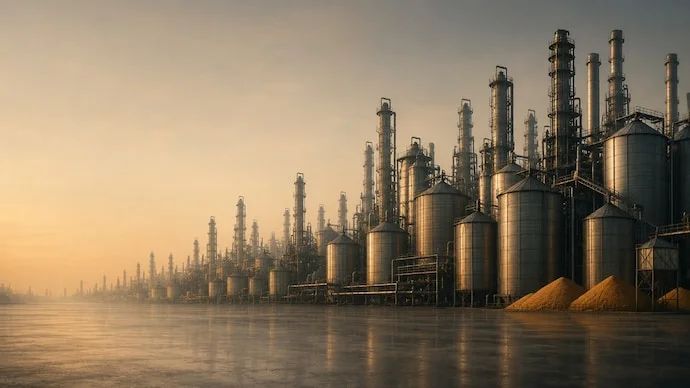
India achieved its 20% ethanol-blending (E20) target five years ahead of schedule, but the rapid expansion of production capacity has created a potential surplus of nearly 700 crore litres annually.
The government’s push for ethanol blending—driven by energy security, forex savings, and emission reduction—accelerated investments in distilleries, with installed capacity now at 2,000 crore litres. However, current domestic demand for ethanol, primarily for petrol blending, stands at 1,200 crore litres per year, leaving industry bodies like the All India Distillers' Association (AIDA) warning of underutilised capacity.
Why India’s Ethanol Capacity Outstrips Demand
India’s ethanol programme, launched in 2001, gained momentum in the last decade through policy interventions and procurement by oil marketing companies. The country now ranks as the world’s third-largest ethanol producer, after the US and Brazil.
According to AIDA, 370 operational distilleries and 40 more in development contribute to the surplus. The association notes a "notional surplus capacity of approximately 700 crore litres" against current requirements for the Ethanol Blended Petrol (EBP) Programme and industrial uses.
Can India Export the Surplus Ethanol?
With domestic demand plateauing, industry stakeholders are exploring exports to countries like Nepal, Bangladesh, and Indonesia, which lack feedstock or distillation capacity. AIDA Deputy Director General Bharti Balaji stated that exporting surplus ethanol could help utilise excess production until domestic demand rises.
However, repayment pressures loom for distilleries. Public sector banks have financed nearly Rs 1 lakh crore annually in ethanol production and infrastructure. Rolling back to E10 is not feasible, as it would jeopardise these investments, per the Ministry of Petroleum and Natural Gas.
What’s Next for India’s Ethanol Policy?
The government has signalled interest in scaling up beyond E20, potentially to E30, but this depends on vehicle compatibility and further studies. Meanwhile, the industry has shifted from capacity-building to resilience-building, balancing surplus production with future demand growth.
Key challenges remain: ensuring optimal use of existing capacity, addressing compatibility issues for older vehicles, and managing trade-offs between ethanol production and food security. The success of the programme may ultimately hinge on consumer adoption and policy adaptability.